

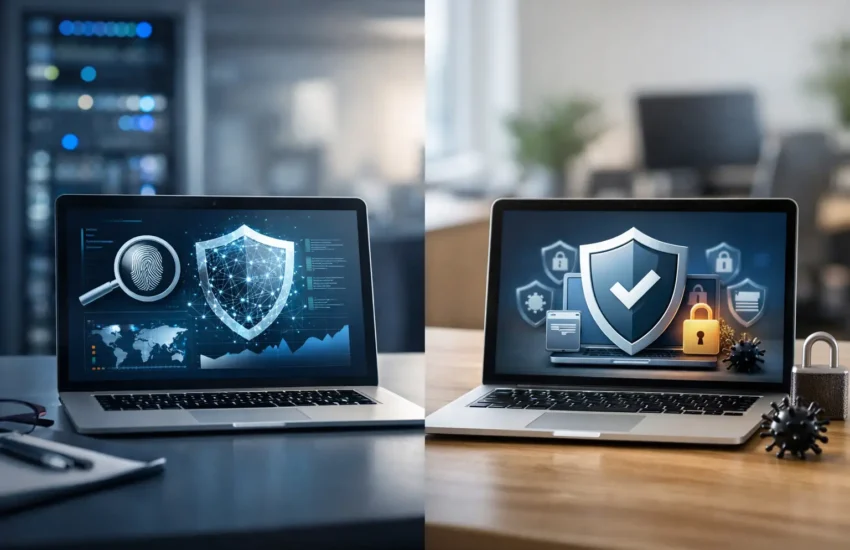
A finance employee opens what looks like a routine shared-document notice. The attachment runs, antivirus finds nothing immediately, and a stolen login is used hours later to access cloud files. This is the practical difference behind EDR vs antivirus for business: one tool may stop known threats at the door, while the other helps your team see, investigate, and contain suspicious activity already moving through an endpoint.
For a startup or growing company, the question is rarely whether security matters. It is how to make a sensible investment without adding tools your team cannot operate. Antivirus remains useful. Endpoint detection and response (EDR) adds visibility and response capability that many businesses now need. The right choice depends on your risks, systems, internal capacity, and the cost of a security incident.
EDR vs Antivirus for Business: The Core Difference
Traditional antivirus is primarily designed to prevent malware from executing on a device. It compares files and activity against known malicious signatures and behavioral indicators. Modern antivirus products are far more capable than the basic tools of a decade ago. Many use cloud intelligence, machine learning, web filtering, and behavior-based detection to identify threats that do not match an old signature.
EDR, short for endpoint detection and response, goes further. It continuously records and analyzes activity on laptops, desktops, servers, and sometimes mobile devices. When it sees suspicious behavior, it can alert security personnel, isolate a device from the network, collect evidence, and support a faster investigation.
The distinction is not simply prevention versus detection. Both can detect and block threats. EDR provides more context after an alert occurs: which process launched the suspicious file, what account was involved, whether other devices show the same activity, and what actions may limit the spread.
That context matters when a phishing attack bypasses initial defenses, an employee installs an unapproved application, or an attacker uses legitimate credentials rather than obvious malware. Businesses do not experience incidents as isolated alerts. They experience them as disrupted operations, inaccessible files, lost productivity, and difficult decisions about whether systems can be trusted.
What Antivirus Does Well
Antivirus is still a baseline control for every business endpoint. It is generally less expensive and easier to deploy than a full EDR platform. For organizations with a small number of managed devices and limited sensitive data, a well-configured business-grade antivirus solution can reduce exposure to common malware, malicious downloads, unsafe websites, and known ransomware variants.
It works best when it is part of a broader foundation that includes timely software patching, multifactor authentication, email security, reliable backups, and employee security awareness. No antivirus product can compensate for unsupported operating systems, shared passwords, or staff members who have unrestricted local administrator access.
Antivirus may be a reasonable primary endpoint control when a company has straightforward technology needs, uses cloud-based business applications, maintains good patch discipline, and has a trusted IT provider monitoring the environment. Even then, it should be centrally managed. If no one reviews device status, verifies policy settings, or responds to detections, the software is only doing part of its job.
Where Antivirus Can Fall Short
The biggest limitation of antivirus is that it may provide limited visibility into an attack that does not look like traditional malware. Cybercriminals increasingly use valid accounts, remote management tools, stolen browser sessions, scripts, and built-in system utilities. Those actions can appear legitimate without the right behavioral context.
Antivirus alerts can also be hard to interpret. A small business owner may receive a notification that a threat was quarantined, but still have unanswered questions. Did the file run? Did it reach shared folders? Is another computer affected? Has the associated account been compromised?
Without endpoint-level investigation and response capabilities, the answer may require manual work during an already stressful event. That delay can increase downtime and create uncertainty around recovery.
What EDR Adds to Your Security Program
EDR is designed to help organizations respond before a suspicious event becomes a business-wide incident. It monitors endpoint activity in greater depth and connects individual signals into a clearer picture of potential attack behavior.
A capable EDR deployment can support actions such as isolating an infected laptop while keeping security staff connected to investigate, terminating harmful processes, identifying related indicators across devices, and preserving forensic information. These capabilities are particularly valuable during ransomware events, credential-based attacks, and attempts to move from one system to another.
EDR also supports a more proactive security posture. Instead of waiting for a user to report that something feels wrong, a monitored EDR service can investigate unusual activity and escalate verified threats. For businesses without an internal security operations center, this is often the practical value of managed detection and response, or MDR, layered on top of EDR technology.
Technology alone does not watch alerts at 2:00 a.m. An EDR tool can generate valuable data, but its effectiveness depends on accurate configuration, alert tuning, threat review, and someone authorized to act when a device needs to be isolated. That operating model should be part of the buying decision.
Cost and Complexity: The Trade-Offs
Antivirus typically has a lower per-user cost and less administrative overhead. It can be a sensible choice for organizations that need to establish essential protections quickly. EDR usually costs more because it provides deeper telemetry, advanced controls, and, in many cases, access to expert monitoring and response services.
However, comparing subscription prices alone can be misleading. Consider the operational cost of an incident. A ransomware event can halt billing, customer service, order processing, and remote work. A compromised email account can create fraudulent payment requests and damage client trust. If an EDR service shortens detection and containment by even a few hours, the difference may be meaningful.
EDR also introduces responsibilities. Your business needs clear policies for device isolation, employee communication, escalation, and recovery. False positives are possible, and overly aggressive settings can interrupt legitimate work. A strong provider tunes protection to your environment rather than applying the same policy to every organization.
How to Choose the Right Level of Endpoint Protection
Start with your business risk, not a feature checklist. A company handling financial records, health information, legal documents, customer data, or intellectual property generally has a stronger case for EDR and ongoing monitoring. The same is true for organizations with remote employees, frequent contractors, multiple locations, cloud administration accounts, or systems that cannot tolerate extended downtime.
Your current IT maturity matters as well. If you do not have centralized device management, an accurate hardware inventory, regular patching, tested backups, and multifactor authentication, address those gaps alongside endpoint protection. EDR is not a substitute for the fundamentals. It is most effective when those fundamentals are working.
Ask prospective providers how they handle the complete response process. You should understand who watches alerts, how quickly they investigate, whether they can isolate devices, when your team is contacted, and what happens after containment. Also ask whether coverage includes servers, remote workers, and the operating systems your business actually uses.
A useful decision framework is to evaluate five areas:
- The sensitivity of the data your employees access and store
- The financial impact of one day of downtime
- The number and location of managed endpoints
- Your ability to investigate and respond to alerts internally
- Regulatory, contractual, or cyber insurance requirements
If these factors point to higher exposure, EDR with managed monitoring is usually the more appropriate investment. If your environment is simpler and your risks are lower, centrally managed business antivirus may be an appropriate starting point, provided it is paired with disciplined IT management and a plan to reassess as you grow.
The Best Answer Is Often a Layered One
EDR and antivirus are not always competing categories. Many modern EDR platforms include next-generation antivirus capabilities, and many security programs use both prevention and response functions within one endpoint platform. The objective is not to collect labels. It is to reduce the likelihood that a single employee action turns into a serious interruption.
For most growing businesses, endpoint security should fit into a larger continuity plan: secure email, identity protection, patch management, network controls, tested backups, and expert support when something goes wrong. When those pieces are coordinated, your business can act with more confidence instead of reacting under pressure.
URBlink helps businesses evaluate endpoint protection in the context of their entire IT environment, so security choices support daily productivity as well as long-term growth. The most useful next step is to review your endpoints, data exposure, and response readiness before an alert forces that conversation.
